
What is aggregate-data modelling?
admixr2 fits pharmacometric PK/PD models to
summary-level data instead of individual records — a
meta-analysis framework for population PK/PD. The input
is digitised aggregate data (means, error bars and
covariances), previously published models, or both, and
the result is one population model with interpretable fixed, random and
covariate effects.
For each study you supply:
- E — observed mean vector (one entry per observation time)
- V — observed covariance matrix (or variance vector)
- n — sample size
- times — observation time points
- ev — dosing event table
The estimators match E and V against their model-predicted
counterparts and return a standard nlmixr2 fit object. Turning a
published figure into E, V and n
is covered in vignette("aggregate-data"); letting a study
carry its own published model instead, in
vignette("datagen").
Four estimators are available:
| Estimator | est = |
Control function | Approach |
|---|---|---|---|
| First-Order | "adfo" |
adfoControl() |
First-order Taylor expansion at η = 0; one rxSolve per NLL eval; fastest |
| Monte Carlo | "admc" |
admControl() |
Sample average over η; asymptotically exact |
| Gauss-Hermite | "adgh" |
adghControl() |
Deterministic quadrature over η; noise-free, unbiased at any IIV |
| Iterative Reweighting MC | "adirmc" |
adirmcControl() |
Proposals fixed per phase; inner loop needs no new rxSolve calls |
Start with adfo for screening and initial estimates.
admc is the workhorse for standard PK models;
adgh is its noise-free alternative, most efficient when
there are few random effects; adirmc suits expensive ODE
solves, high-dimensional IIV or poor starting values. See
vignette("estimator-comparison").
The examplomycin dataset
examplomycin ships with admixr2: 500 simulated subjects
from a two-compartment PK model with first-order absorption (100 mg oral
dose, sampled at 0.1, 0.25, 0.5, 1, 2, 3, 5, 8, and 12 h). True
parameters: CL = 5 L/h, V1 = 10 L, V2 = 30 L, Q = 10 L/h, ka = 1 h⁻¹;
IIV = 0.3 (SD on log scale) for all parameters; proportional error SD =
0.2.
library(admixr2)
library(rxode2)
library(nlmixr2)

data("examplomycin")
head(examplomycin[examplomycin$EVID == 0, c("ID", "TIME", "DV")], 9)
#>     ID  TIME    DV
#> 2  460  0.10 0.752
#> 3  460  0.25 1.932
#> 4  460  0.50 3.694
#> 5  460  1.00 3.479
#> 6  460  2.00 4.003
#> 7  460  3.00 3.825
#> 8  460  5.00 1.756
#> 9  460  8.00 1.155
#> 10 460 12.00 0.742
Computing aggregate statistics
Reshape individual records into a subjects × times matrix, then compute E and V:
dv_mat <- admVignetteDvMatrix()          # 500 subjects x 9 times

E     <- colMeans(dv_mat)
V     <- cov.wt(dv_mat, method = "ML")$cov
n     <- nrow(dv_mat)                    # 500
times <- as.numeric(colnames(dv_mat))

round(E, 2)
#>  0.1 0.25  0.5    1    2    3    5    8   12
#> 0.97 1.94 2.79 3.02 2.26 1.65 1.06 0.75 0.51
admVignetteDvMatrix() is a helper defined in this
vignette’s setup file; it does nothing but reshape
examplomycin’s individual records into one row per subject
and one column per time.
V’s off-diagonal entries capture within-subject
correlation across time. Using the full matrix
(method = "cov") typically tightens estimates against the
diagonal-only approximation (method = "var"); admixr2 picks
the method from the structure of V.
Model definition
Models use standard nlmixr2 syntax with mu-referenced log-scale parameters:
pk_model <- function() {
  ini({
    tcl     <- log(5)  ; label("Log clearance (L/hr)")
    tv1     <- log(10) ; label("Log central volume (L)")
    tv2     <- log(30) ; label("Log peripheral volume (L)")
    tq      <- log(10) ; label("Log inter-compartmental CL (L/hr)")
    tka     <- log(1)  ; label("Log absorption rate constant (1/hr)")
    prop.sd <- c(0, 0.2); label("Proportional residual error SD")
    eta.cl ~ 0.09
    eta.v1 ~ 0.09
    eta.v2 ~ 0.09
    eta.q  ~ 0.09
    eta.ka ~ 0.09
  })
  model({
    cl <- exp(tcl + eta.cl)
    v1 <- exp(tv1 + eta.v1)
    v2 <- exp(tv2 + eta.v2)
    q  <- exp(tq  + eta.q)
    ka <- exp(tka + eta.ka)
    d/dt(depot)      <- -ka * depot
    d/dt(central)    <- ka * depot - (cl/v1 + q/v1) * central + (q/v2) * peripheral
    d/dt(peripheral) <- (q/v1) * central - (q/v2) * peripheral
    cp <- central / v1
    cp ~ prop(prop.sd)
  })
}
Writing each parameter as exp(tcl + eta.cl) is
mu-referencing: the fixed effect and its random effect
enter additively on the log scale. admixr2 uses that pairing to get
analytical gradients from sensitivity equations — see Advanced
usage, which also covers parameters with no random effect.
Fitting
Pass one or more named studies to admControl():
fit <- nlmixr2(
  pk_model, admData(), est = "admc",
  control = admControl(
    studies   = list(examplomycin = study),
    n_sim     = 5000L,
    cov_n_sim = 10000L,
    maxeval   = 300L,
    seed      = 1L
  )
)
Inspecting the fit
print(fit)
── nlmixr² admc ──

          OBJF       AIC       BIC Log-likelihood
admc -3690.262 -3668.262 -3597.732       1845.131

── Time (sec fit$time): ──

  optimize covariance other elapsed
1   40.024     15.155     0  55.179

── Population Parameters (fit$parFixed or fit$parFixedDf): ──

                                  Parameter    Est.       SE  %RSE
tcl                    Log clearance (L/hr)   1.602  0.02000 1.248
tv1                  Log central volume (L)   2.328   0.1320 5.670
tv2               Log peripheral volume (L)   3.397  0.05338 1.571
tq        Log inter-compartmental CL (L/hr)   2.276  0.02729 1.199
tka     Log absorption rate constant (1/hr) 0.02979   0.1230 412.9
prop.sd      Proportional residual error SD  0.1895 0.003282 1.732
        Back-transformed(95%CI) BSV(CV%) Shrink(SD)%
tcl        4.963 (4.772, 5.161)    32.62         NaN
tv1        10.26 (7.920, 13.29)    33.15         NaN
tv2        29.89 (26.92, 33.18)    31.81         NaN
tq         9.738 (9.231, 10.27)    33.68         NaN
tka       1.030 (0.8096, 1.311)    31.87         NaN
prop.sd 0.1895 (0.1831, 0.1960)

  Covariance Type (fit$covMethod): r,s
  Some strong fixed parameter correlations exist (fit$cor) :
                cor:tv1,tcl             cor:tv2,tcl              cor:tq,tcl
                 0.360                  -0.527                   0.210
            cor:tka,tcl         cor:prop.sd,tcl       cor:om.eta.cl,tcl
                 0.386                  0.0569                  -0.102
      cor:om.eta.v1,tcl       cor:om.eta.v2,tcl        cor:om.eta.q,tcl
                -0.333                  -0.191                   0.265
      cor:om.eta.ka,tcl             cor:tv2,tv1              cor:tq,tv1
                 0.316                  -0.851                   0.233
            cor:tka,tv1         cor:prop.sd,tv1       cor:om.eta.cl,tv1
                 0.982                 -0.0190                -0.00708
      cor:om.eta.v1,tv1       cor:om.eta.v2,tv1        cor:om.eta.q,tv1
                -0.672                  0.0598                   0.501
      cor:om.eta.ka,tv1              cor:tq,tv2             cor:tka,tv2
                 0.693                  -0.274                  -0.857
        cor:prop.sd,tv2       cor:om.eta.cl,tv2       cor:om.eta.v1,tv2
              -0.00614                  0.0506                   0.625
      cor:om.eta.v2,tv2        cor:om.eta.q,tv2       cor:om.eta.ka,tv2
                0.0749                  -0.439                  -0.642
             cor:tka,tq          cor:prop.sd,tq        cor:om.eta.cl,tq
                 0.271                -0.00629                 -0.0495
       cor:om.eta.v1,tq        cor:om.eta.v2,tq         cor:om.eta.q,tq
                -0.138                  0.0734                   0.318
       cor:om.eta.ka,tq         cor:prop.sd,tka       cor:om.eta.cl,tka
                0.0656                 -0.0229                -0.00878
      cor:om.eta.v1,tka       cor:om.eta.v2,tka        cor:om.eta.q,tka
                -0.666                  0.0557                   0.527
      cor:om.eta.ka,tka   cor:om.eta.cl,prop.sd   cor:om.eta.v1,prop.sd
                 0.683                 -0.0292                 -0.0525
  cor:om.eta.v2,prop.sd    cor:om.eta.q,prop.sd   cor:om.eta.ka,prop.sd
                -0.195                  -0.161                  0.0196
cor:om.eta.v1,om.eta.cl cor:om.eta.v2,om.eta.cl  cor:om.eta.q,om.eta.cl
                0.0363                  -0.158                -0.00687
cor:om.eta.ka,om.eta.cl cor:om.eta.v2,om.eta.v1  cor:om.eta.q,om.eta.v1
               -0.0317                 -0.0249                  -0.257
cor:om.eta.ka,om.eta.v1  cor:om.eta.q,om.eta.v2 cor:om.eta.ka,om.eta.v2
                -0.887                  -0.132                  0.0377
 cor:om.eta.ka,om.eta.q
                 0.219


  No correlations in between subject variability (BSV) matrix
  Full BSV covariance (fit$omega) or correlation (fit$omegaR; diagonals=SDs)
  Distribution stats (mean/skewness/kurtosis/p-value) available in fit$shrink
  Censoring (fit$censInformation): No censoring
  Minimization message (fit$message):
    NLOPT_XTOL_REACHED: Optimization stopped because xtol_rel or xtol_abs (above) was reached.
Key entries in fit$env$admExtra:
fit$objective                    # -2 log-likelihood
#> [1] -3690.262
fit$env$admExtra$struct          # structural parameters (log scale)
#>        tcl        tv1        tv2         tq        tka
#> 1.60197115 2.32807483 3.39738144 2.27604233 0.02978847
fit$env$admExtra$sigma_var       # residual variance(s)
#>    prop.sd
#> 0.03592041

logLik(fit)
#> 'log Lik.' 1845.131 (df=11)
AIC(fit)
#> [1] -3668.262
The estimated between-subject covariance matrix
Omega:
knitr::kable(fit$env$admExtra$omega, digits = 4,
caption = "Estimated Omega (between-subject covariance).")| 0.1011 | 0.0000 | 0.0000 | 0.0000 | 0.0000 |
| 0.0000 | 0.1042 | 0.0000 | 0.0000 | 0.0000 |
| 0.0000 | 0.0000 | 0.0964 | 0.0000 | 0.0000 |
| 0.0000 | 0.0000 | 0.0000 | 0.1075 | 0.0000 |
| 0.0000 | 0.0000 | 0.0000 | 0.0000 | 0.0967 |
Diagnostic plots
plot() draws up to four panel types and returns them as
a named list of ggplot2 objects:
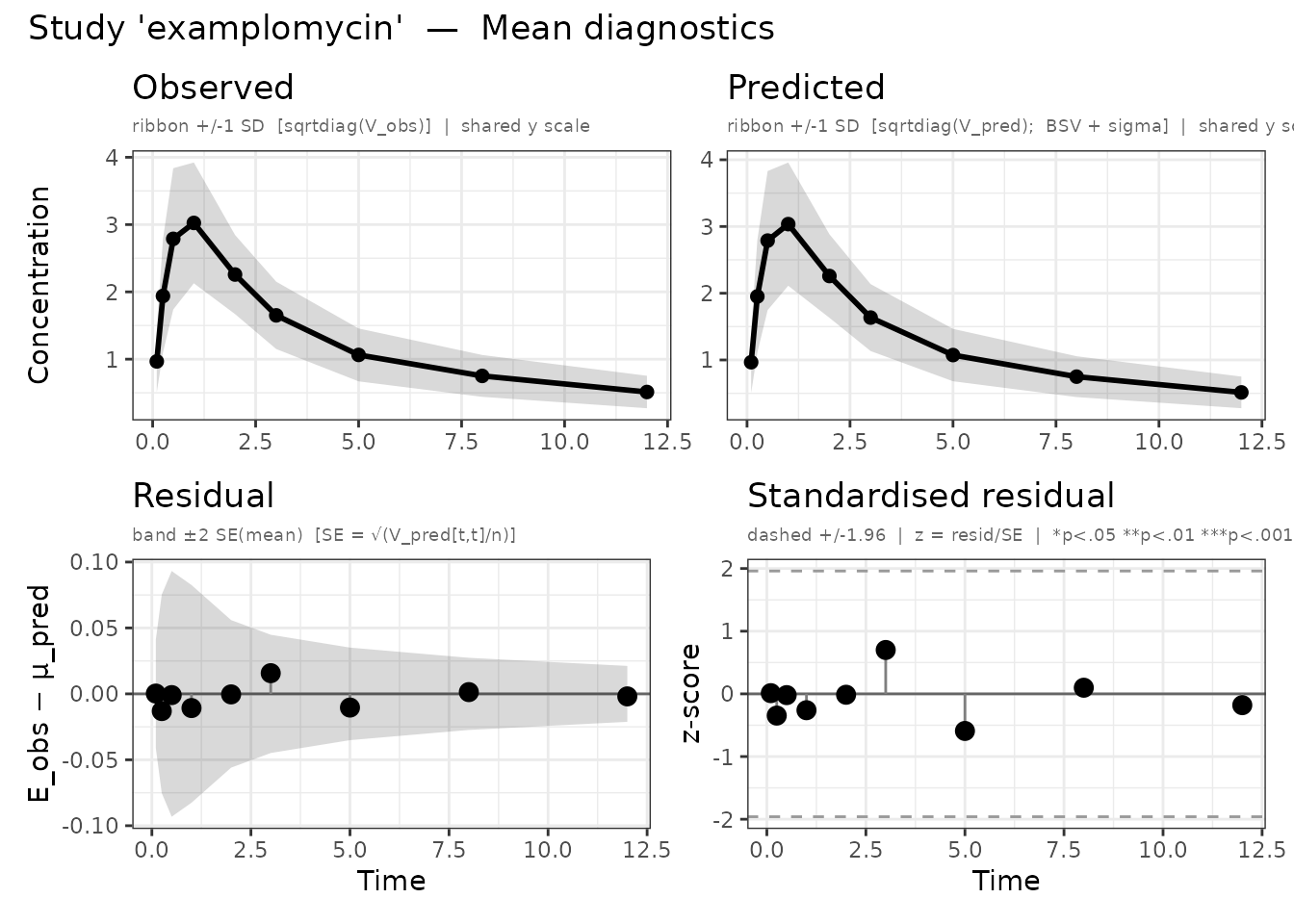
Mean diagnostics (observed vs predicted, with residuals), then the NLL convergence trace.
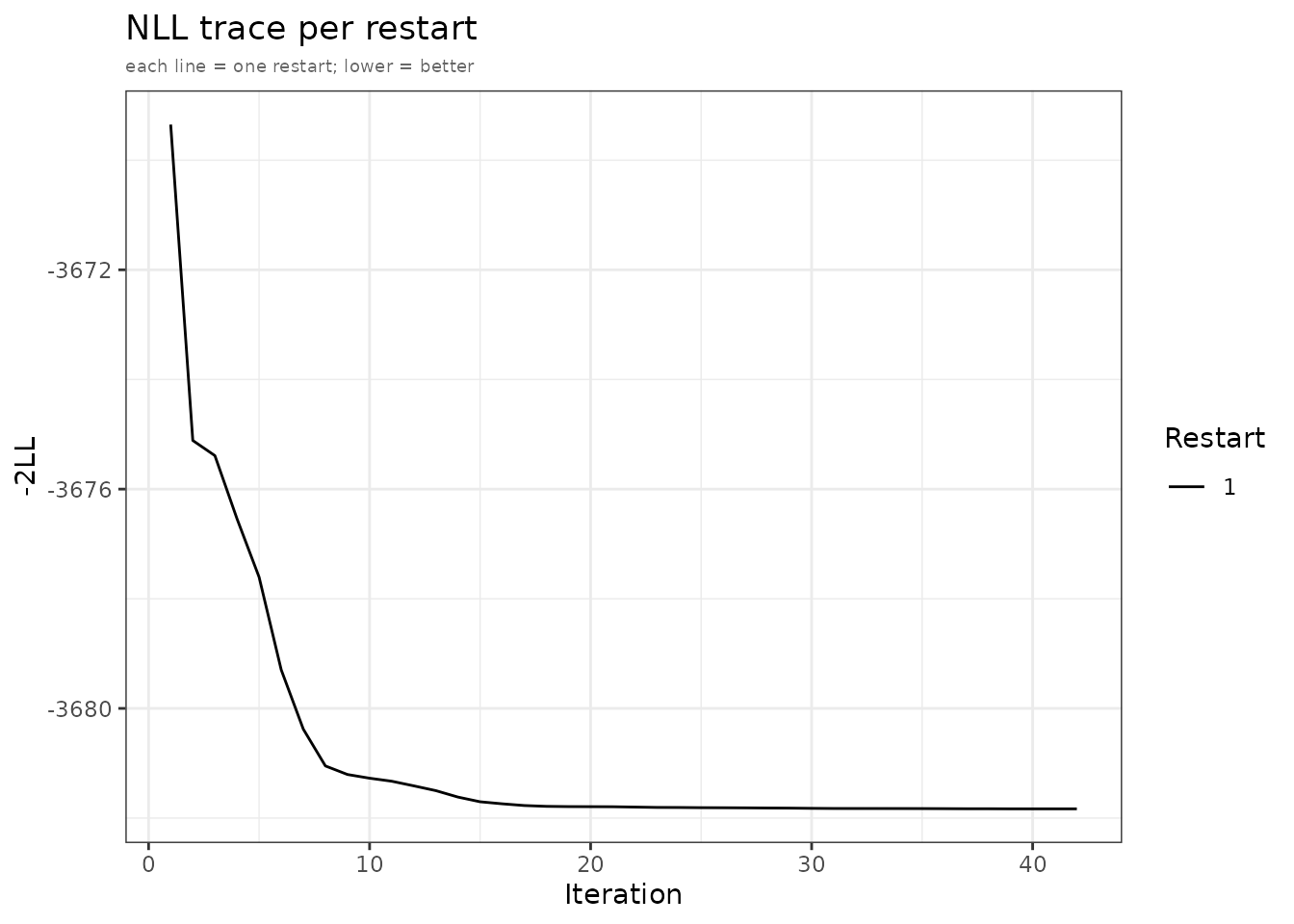
Mean diagnostics (observed vs predicted, with residuals), then the NLL convergence trace.
All four panel types and their customisation are covered in
vignette("diagnostic-plots").
Where to next
-
From a published figure to E, V and
n — turn published summaries into
E,Vandn - Simulating data & using published models — the model-as-input path
- Multiple studies — meta-analysis across several studies
- Estimator comparison — choosing a backend
-
Choosing a residual error model —
what
cp ~ prop(...)does toEandV