Estimator comparison: adfo, admc, adgh and adirmc
Source:vignettes/estimator-comparison.Rmd
estimator-comparison.RmdFour estimators, one interface
All four take the same model and study specification and return the
same admFit object. They share one likelihood and differ
only in how they approximate the predicted population mean and
covariance.
The shared integration problem
For each study the observed data are a mean vector and a covariance matrix computed from subjects. Under a multivariate normal approximation the aggregate log-likelihood is
where and are the model-predicted population mean and covariance of the observations. For a nonlinear model these are integrals over the random-effects distribution :
that is, the law of total variance. Writing
is
correct only when the residual variance does not depend on the
prediction — i.e. for purely additive error. With
prop(), pow() or lnorm() the
residual variance is a function of
,
so
,
and lnorm() additionally scales the conditional
mean by
,
which scales the whole covariance rather than just its diagonal.
Evaluating the residual at the population mean instead — the NONMEM “no
–
interaction” convention — understates
by
for proportional error, and admixr2 does not do
this.
For nonlinear these integrals have no closed form, and evaluating them is the only thing the four estimators disagree about.
First-Order (FO): Taylor expansion at
adfo sidesteps the integral entirely by approximating
with its first-order Taylor expansion around
:
Substituting into the population moments gives closed-form expressions:
comes from one rxSolve, via sensitivity equations that augment the ODE
system with
— no finite differences, no extra solve per eta. That makes
adfo the fastest and fully deterministic: one rxSolve per
NLL evaluation.
When it holds: exactly, when is linear in . Otherwise the true population covariance exceeds , so FO underestimates , and the bias grows with the nonlinearity.
AIC: adfo evaluates a
linearised likelihood, on a different scale from the other
three. Never compare its objective across estimators.
Monte Carlo (MC): sample average over
admc estimates the population integrals directly by
drawing
samples
and computing sample moments:
Nothing is approximated about , so the estimator is asymptotically exact as . Sobol sequences (the default) typically need 2–5× fewer samples than plain normal draws for the same precision.
The cost is that every NLL evaluation takes rxSolve calls, one per sample. The analytical gradient (sensitivity equations for mu-referenced parameters, an added first-order direction set for the rest) adds none, but the base cost per optimizer step stays one rxSolve.
Asymptotically exact, with AIC comparable across admc
fits, and reliable on standard 1–2 compartment models at moderate IIV.
Against that: slower than adfo, and at low
n_sim the MC noise in the gradient can set the optimiser
oscillating.
Iterative Reweighting MC (IRMC): proposals fixed, inner loop free
adirmc attacks admc’s bottleneck —
fresh rxSolve calls at every optimizer step — by decoupling
proposal generation from optimisation.
Each outer phase draws proposals once and holds them fixed for the whole inner optimisation, so evaluating the NLL is matrix operations only. Reweighting the proposals by their likelihood under the current keeps the inner objective valid as the parameters move:
The inner optimizer therefore runs to convergence for almost nothing; proposals refresh only between phases, whose box constraints tighten progressively to guide global convergence.
That suits complex ODE models where each solve is
expensive: the total number of solves scales with phases rather than
optimizer steps. It also tolerates poor starting values, the inner loop
being deterministic rather than re-sampled, and its AIC is comparable to
admc’s. The cost is per-phase overhead, which does not pay
off on a simple, well-initialised problem with cheap solves.
Gauss-Hermite (GH): deterministic quadrature over
adgh evaluates the integrals exactly, up to the
quadrature rule, on a tensor-product Gauss-Hermite grid over
.
Golub-Welsch gives the nodes
and weights
;
the Cholesky factor maps standard-normal nodes into the correlated
space:
With nodes per dimension and random effects the grid holds points, and the objective is fully deterministic — no MC noise, so a clean gradient and a well-conditioned Hessian.
It is reproducible without fixing n_sim, makes no
approximation to
(so unlike FO it is unbiased at any IIV), and its AIC is comparable to
admc and adirmc. Below about four etas
stays small —
— and adgh beats admc at equal accuracy. Above
that the grid grows exponentially
(,
),
and there is no inner-loop saving as in adirmc: every NLL
evaluation runs all
solves. For high-dimensional IIV, use admc or
adirmc.
Common setup
library(admixr2)
library(rxode2)
library(nlmixr2)
library(ggplot2)

# The examplomycin study and model from `vignette("admixr2")`, supplied by the
# shared helpers in this vignette's setup file. All four fits below differ only
# in the estimator, so the model and the data are held fixed here.
pk_model <- admVignetteModel
study    <- c(admVignetteStats(), list(ev = rxode2::et(amt = 100)))
It is mu-referenced (cl <- exp(tcl + eta.cl)), which
is what gives all four estimators an analytical gradient from
sensitivity equations — see Advanced
usage.
Fitting with adfo
The fastest, and the natural starting point for screening or for initial estimates to hand to MC.
fit_fo <- nlmixr2(
  pk_model, admData(), est = "adfo",
  control = adfoControl(
    studies  = list(examplomycin = study),
    maxeval  = 500L,
    seed     = 1L
  )
)
Fitting with admc
fit_mc <- nlmixr2(
  pk_model, admData(), est = "admc",
  control = admControl(
    studies   = list(examplomycin = study),
    n_sim     = 5000L,
    cov_n_sim = 10000L,
    maxeval   = 300L,
    seed      = 1L
  )
)
Fitting with adirmc
Slower per evaluation, but more robust to poor starting values and a
high-dimensional
.
These settings keep the vignette build fast; raise n_sim
for real work.
fit_irmc <- nlmixr2(
  pk_model, admData(), est = "adirmc",
  control = adirmcControl(
    studies         = list(examplomycin = study),
    n_sim           = 2000L,
    phases          = c(2, 1, 0.5, 0.01),
    cov_n_sim       = 10000L,
    omega_expansion = 1.5,
    seed            = 1L
  )
)
Fitting with adgh
A drop-in alternative to admc when there are few etas.
The five-eta model here gives
nodes, about the practical limit. Start at n_nodes = 3 (243
nodes) and go to 5 or 7 only if IIV is large (SD > 0.4).
fit_gh <- nlmixr2(
  pk_model, admData(), est = "adgh",
  control = adghControl(
    studies  = list(examplomycin = study),
    n_nodes  = 5L,
    maxeval  = 300L,
    seed     = 1L
  )
)
Comparing parameter estimates
Both should land near the truth (CL = 5, V1 = 10, V2 = 30, Q = 10, ka = 1; IIV variance 0.09 throughout; prop.sd = 0.2). examplomycin has moderate IIV and is near-linear in , so FO bias is small here.
get_pars <- function(fit) {
  s  <- fit$env$admExtra$struct
  om <- diag(fit$env$admExtra$omega)
  sg <- sqrt(unlist(fit$env$admExtra$sigma_var))
  c(exp(s), om, sg)
}

tbl <- data.frame(
  Parameter = c(
    paste0("exp(", names(fit_fo$env$admExtra$struct), ")"),
    paste0("var(", fit_fo$env$admExtra$eta_col_names, ")"),
    "prop.sd"
  ),
  True = c(5, 10, 30, 10, 1, rep(0.09, 5), 0.2),
  adfo = round(get_pars(fit_fo), 4),
  admc = round(get_pars(fit_mc), 4)
)

knitr::kable(tbl, caption = "Parameter estimates vs true values")| Parameter | True | adfo | admc |
|---|---|---|---|
| exp(tcl) | 5.00 | 4.9100 | 4.9628 |
| exp(tv1) | 10.00 | 7.3161 | 10.2582 |
| exp(tv2) | 30.00 | 32.3637 | 29.8857 |
| exp(tq) | 10.00 | 10.0853 | 9.7381 |
| exp(tka) | 1.00 | 0.8043 | 1.0302 |
| var(eta.cl) | 0.09 | 0.0968 | 0.1011 |
| var(eta.v1) | 0.09 | 0.1427 | 0.1042 |
| var(eta.v2) | 0.09 | 0.0905 | 0.0964 |
| var(eta.q) | 0.09 | 0.0938 | 0.1075 |
| var(eta.ka) | 0.09 | 0.0777 | 0.0967 |
| prop.sd | 0.20 | 0.1908 | 0.1895 |
Comparing objectives
admc and adirmc evaluate the same
likelihood, so their -2LL values compare directly. adfo’s
is linearised, on a different scale, and must not be
set against them or used for cross-estimator AIC:
cat(sprintf("adfo  -2LL = %.2f   AIC = %.2f\n", fit_fo$objective, AIC(fit_fo)))
#> adfo  -2LL = -3676.41   AIC = -3654.41
cat(sprintf("admc  -2LL = %.2f   AIC = %.2f\n", fit_mc$objective, AIC(fit_mc)))
#> admc  -2LL = -3690.26   AIC = -3668.26
Use AIC only within the same estimator for model selection.
NLL convergence traces
plots_fo <- plot(fit_fo, which = "nll")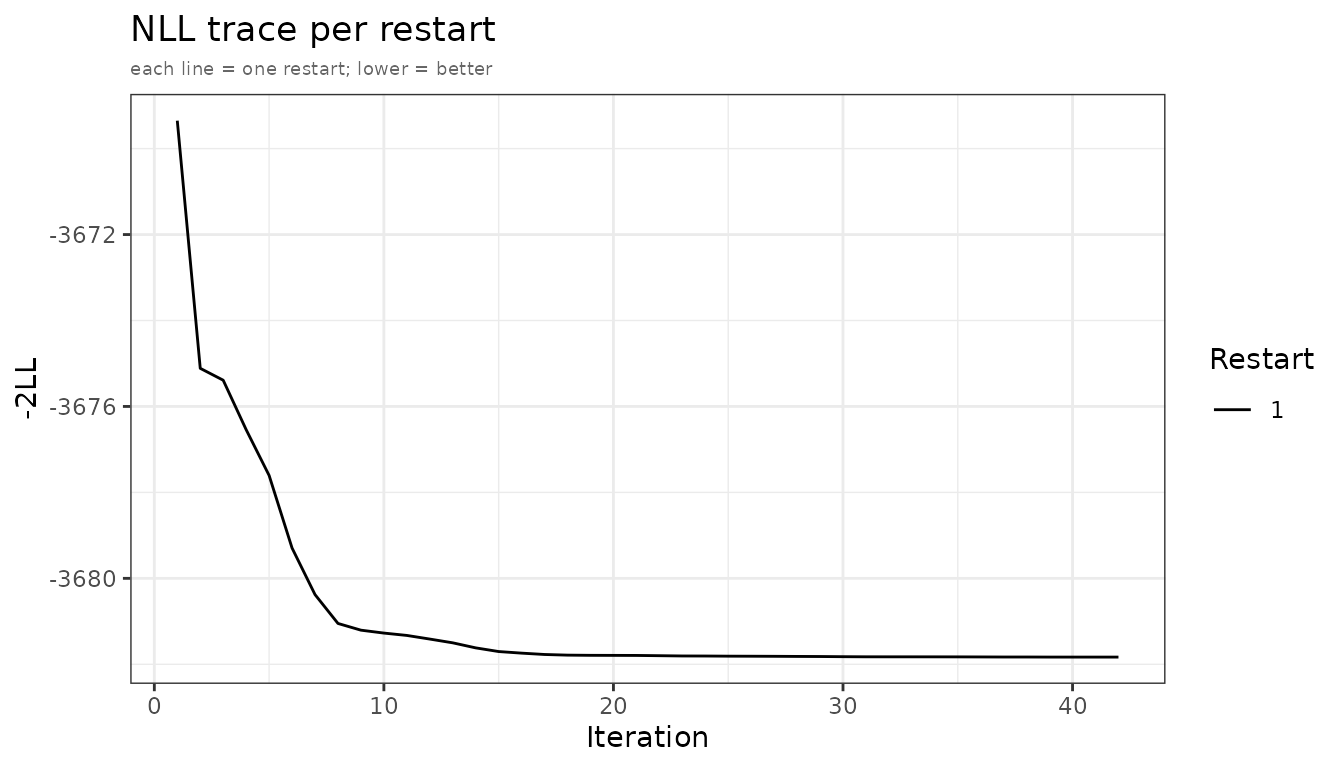
adfo and admc NLL convergence traces.
plots_mc <- plot(fit_mc, which = "nll")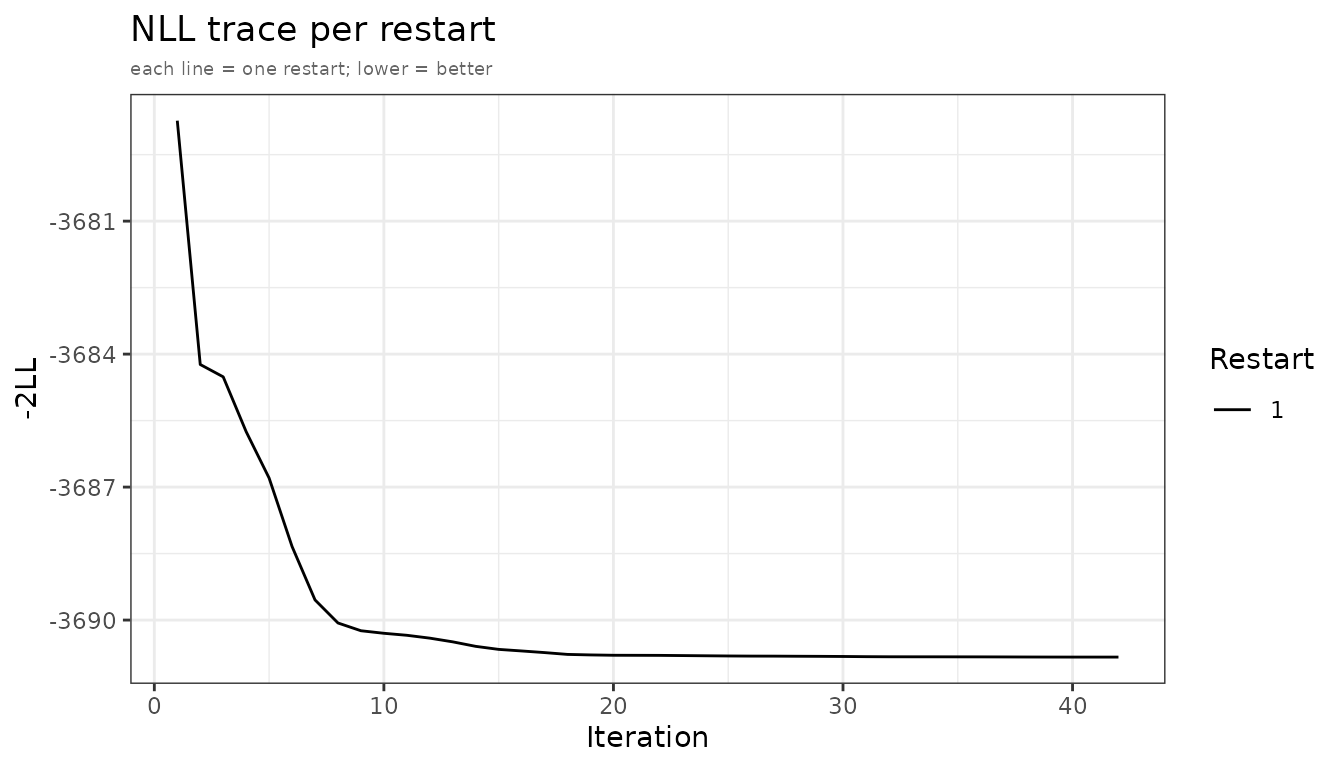
adfo and admc NLL convergence traces.
An adirmc trace shows outer phases rather than
individual L-BFGS steps, so the jumps where box constraints tighten are
expected.
When to use each
| Situation | Recommendation |
|---|---|
| Rapid model screening, many candidate models |
adfo — fastest per evaluation |
| Initial estimates before MC/GH refinement |
adfo then hand off to admc or
adgh
|
| Weak IIV (CV < 20 %) and near-linear model |
adfo estimates reliable for inference |
| Standard 1–2 compartment PK, ≤ 4 etas |
adgh — noise-free, faster than MC at equivalent
accuracy |
| Standard 1–2 compartment PK, ≥ 5 etas or large IIV |
admc with grad = "sens"
|
| Initial exploration or poor starting values |
admc with n_restarts >= 3
|
| Complex ODE system with expensive solves |
adirmc — inner loop needs no new rxSolve calls |
| High-dimensional Omega (≥ 5 etas) |
adirmc — inner loop scales with phases not steps |
| Non-Gaussian or bounded IIV |
adirmc with omega_expansion > 1
|
| Optimal design / design evaluation (matched moments) |
adgh with
datagenControl(method = "gh")
|
| Need exact likelihood for AIC comparison across models |
admc, adgh, or adirmc (not
adfo) |
| Maximum reproducibility, no MC noise |
adfo or adgh (both deterministic) |
Every argument, with its default, is in ?adfoControl,
?admControl, ?adghControl and
?adirmcControl.
See also
- Choosing a residual error model — which error models each estimator supports
- Advanced usage — gradient modes, restarts, and AIC/BIC model comparison
- Getting started