Why multiple studies?
Passing several studies to admControl() fits them
simultaneously, minimising the sum of per-study NLLs under one shared
set of population parameters. This is meta-analysis,
the core use case: summary statistics from several trials that may
differ in dose, size or schedule, and one population model consistent
with all of them. Each study’s E, V and
n can come from a digitised figure
(vignette("aggregate-data")) or from its own published
model (vignette("datagen")).
Two trials that differ
The point of a meta-analysis is that the studies are not interchangeable, so this one combines a trial we hold individual records for with a trial we have only summary statistics from — at a different dose, a sparser schedule and a different size.
library(admixr2)
library(rxode2)
library(nlmixr2)
library(ggplot2)

# Trial A: 500 subjects at 100 mg, richly sampled. Individual records, reduced
# to the E, V and n a publication would print.
dv_mat  <- admVignetteDvMatrix()      # 500 subjects x 9 times
trial_a <- admVignetteStats(dv_mat)
times_a <- trial_a$times

# Trial B: published as summary statistics only -- 120 subjects at 200 mg, four
# sampling times. datagen() turns its model into the aggregate data it implies,
# which is what makes a published study a direct input; see vignette("datagen").
times_b <- c(0.5, 2, 6, 12)
trial_b <- datagen(
  studies = list(b = list(times = times_b,
                          ev    = rxode2::et(amt = 200),
                          n     = 120L)),
  model   = admVignetteModel,
  control = datagenControl(n_sim = 10000L, seed = 1L)
)$b
admVignetteDvMatrix() and
admVignetteStats() come from this vignette’s setup file:
the first reshapes examplomycin into one row per subject,
the second takes E, V and n off
it.
Trial B is simulated here so the vignette has a second study to
combine; in practice its E, V and
n would be digitised from the paper
(vignette("aggregate-data")) or derived from the model the
paper published.
Comparing the two observed profiles
The two are on different doses, so they should not lie on top of each other — that separation is the information a joint fit uses.
df_obs <- rbind(
  data.frame(trial = "Trial A (100 mg, n = 500)", time = times_a,
             mean = trial_a$E,
             lo   = trial_a$E - sqrt(diag(trial_a$V)),
             hi   = trial_a$E + sqrt(diag(trial_a$V))),
  data.frame(trial = "Trial B (200 mg, n = 120)", time = times_b,
             mean = trial_b$E,
             lo   = trial_b$E - sqrt(diag(trial_b$V)),
             hi   = trial_b$E + sqrt(diag(trial_b$V)))
)

ggplot(df_obs, aes(x = time, y = mean, colour = trial, fill = trial)) +
  geom_ribbon(aes(ymin = lo, ymax = hi), alpha = 0.15, colour = NA) +
  geom_line(linewidth = 1) +
  geom_point(size = 2.5) +
  scale_x_log10(breaks = sort(unique(c(times_a, times_b)))) +
  scale_colour_manual(values = c("Trial A (100 mg, n = 500)" = "#0072B2",
                                 "Trial B (200 mg, n = 120)" = "#D55E00")) +
  scale_fill_manual(  values = c("Trial A (100 mg, n = 500)" = "#0072B2",
                                 "Trial B (200 mg, n = 120)" = "#D55E00")) +
  labs(title  = "Observed mean ± 1 SD by trial",
       x      = "Time (h, log scale)",
       y      = "Concentration",
       colour = NULL, fill = NULL) +
  theme_bw()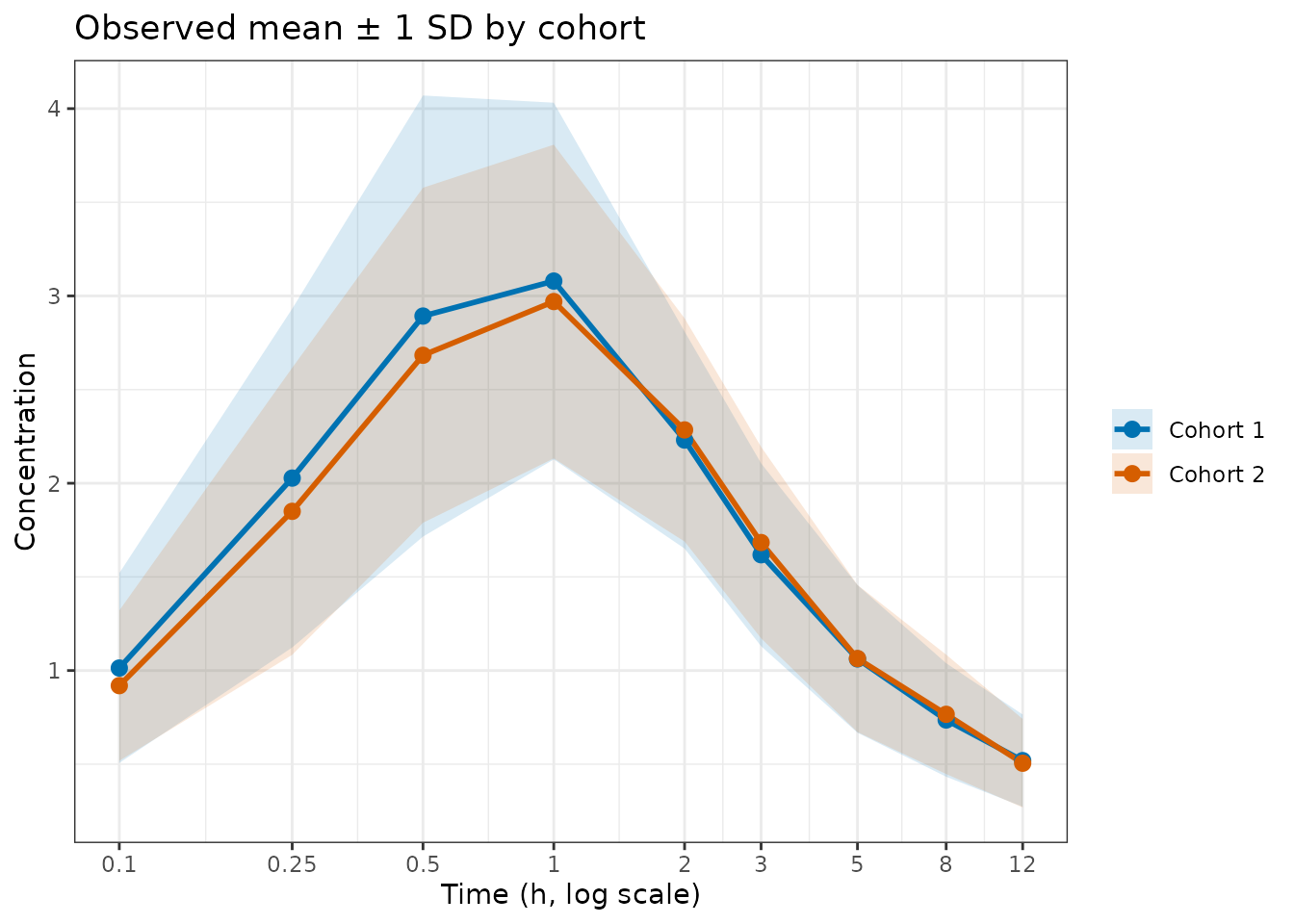
Observed mean ± 1 SD for each trial on a log time axis. Trial B is at twice the dose and four sampling times.
Model definition
The two-compartment model from Getting started, supplied by this vignette’s setup file and fitted to both trials at once:
pk_model <- admVignetteModelFitting with two studies
Pass both trials as a named list. Each entry carries its own
times, ev, V, n and
method, which is what lets them differ:
fit_multi <- nlmixr2(
  pk_model, admData(), est = "admc",
  control = admControl(
    studies = list(
      trial_a = list(E = trial_a$E, V = trial_a$V, n = trial_a$n,
                     times = times_a, ev = rxode2::et(amt = 100)),
      trial_b = list(E = trial_b$E, V = trial_b$V, n = trial_b$n,
                     times = times_b, ev = rxode2::et(amt = 200))
    ),
    n_sim     = 5000L,
    cov_n_sim = 10000L,
    maxeval   = 300L,
    seed      = 1L
  )
)

print(fit_multi)
── nlmixr² admc ──

          OBJF       AIC       BIC Log-likelihood
admc -3351.844 -3329.844 -3258.199       1675.922

── Time (sec fit_multi$time): ──

  optimize covariance other elapsed
1   68.437      30.52     0  98.957

── Population Parameters (fit_multi$parFixed or fit_multi$parFixedDf): ──

                                  Parameter    Est.       SE  %RSE
tcl                    Log clearance (L/hr)   1.603  0.01771 1.105
tv1                  Log central volume (L)   2.328   0.1293 5.552
tv2               Log peripheral volume (L)   3.398  0.04947 1.456
tq        Log inter-compartmental CL (L/hr)   2.281  0.02542 1.114
tka     Log absorption rate constant (1/hr) 0.02919   0.1192 408.2
prop.sd      Proportional residual error SD  0.1900 0.003277 1.725
        Back-transformed(95%CI) BSV(CV%) Shrink(SD)%
tcl        4.967 (4.797, 5.142)    32.32         NaN
tv1        10.26 (7.963, 13.22)    32.98         NaN
tv2        29.90 (27.14, 32.95)    32.07         NaN
tq         9.789 (9.314, 10.29)    33.66         NaN
tka       1.030 (0.8152, 1.301)    31.79         NaN
prop.sd 0.1900 (0.1835, 0.1964)

  Covariance Type (fit_multi$covMethod): r,s
  Some strong fixed parameter correlations exist (fit_multi$cor) :
                cor:tv1,tcl             cor:tv2,tcl              cor:tq,tcl
                 0.342                  -0.508                   0.202
            cor:tka,tcl         cor:prop.sd,tcl       cor:om.eta.cl,tcl
                 0.367                  0.0553                 -0.0961
      cor:om.eta.v1,tcl       cor:om.eta.v2,tcl        cor:om.eta.q,tcl
                -0.322                  -0.191                   0.249
      cor:om.eta.ka,tcl             cor:tv2,tv1              cor:tq,tv1
                 0.305                  -0.856                   0.211
            cor:tka,tv1         cor:prop.sd,tv1       cor:om.eta.cl,tv1
                 0.984                 -0.0463                -0.00151
      cor:om.eta.v1,tv1       cor:om.eta.v2,tv1        cor:om.eta.q,tv1
                -0.683                  0.0883                   0.500
      cor:om.eta.ka,tv1              cor:tq,tv2             cor:tka,tv2
                 0.701                  -0.247                  -0.861
        cor:prop.sd,tv2       cor:om.eta.cl,tv2       cor:om.eta.v1,tv2
                0.0142                  0.0456                   0.632
      cor:om.eta.v2,tv2        cor:om.eta.q,tv2       cor:om.eta.ka,tv2
                0.0501                  -0.438                  -0.648
             cor:tka,tq          cor:prop.sd,tq        cor:om.eta.cl,tq
                 0.253                 -0.0202                 -0.0463
       cor:om.eta.v1,tq        cor:om.eta.v2,tq         cor:om.eta.q,tq
                -0.111                  0.0774                   0.337
       cor:om.eta.ka,tq         cor:prop.sd,tka       cor:om.eta.cl,tka
                0.0402                 -0.0492                -0.00304
      cor:om.eta.v1,tka       cor:om.eta.v2,tka        cor:om.eta.q,tka
                -0.675                  0.0835                   0.528
      cor:om.eta.ka,tka   cor:om.eta.cl,prop.sd   cor:om.eta.v1,prop.sd
                 0.689                 -0.0340                 -0.0251
  cor:om.eta.v2,prop.sd    cor:om.eta.q,prop.sd   cor:om.eta.ka,prop.sd
                -0.221                  -0.188                 -0.0106
cor:om.eta.v1,om.eta.cl cor:om.eta.v2,om.eta.cl  cor:om.eta.q,om.eta.cl
                0.0335                  -0.161                 0.00154
cor:om.eta.ka,om.eta.cl cor:om.eta.v2,om.eta.v1  cor:om.eta.q,om.eta.v1
               -0.0291                 -0.0495                  -0.260
cor:om.eta.ka,om.eta.v1  cor:om.eta.q,om.eta.v2 cor:om.eta.ka,om.eta.v2
                -0.897                  -0.103                  0.0636
 cor:om.eta.ka,om.eta.q
                 0.225


  No correlations in between subject variability (BSV) matrix
  Full BSV covariance (fit_multi$omega)
    or correlation (fit_multi$omegaR; diagonals=SDs)
  Distribution stats (mean/skewness/kurtosis/p-value) available in $shrink
  Censoring (fit_multi$censInformation): No censoring
  Minimization message (fit_multi$message):
    NLOPT_FAILURE: Generic failure code.
Nothing above assumes the two share a dose or a schedule. The objective is the sum of per-study negative log-likelihoods under one set of population parameters, and each study is predicted at its own dosing and its own times.
Per-study diagnostic plots
plot() produces separate panels per study, named
mean_<study> and cov_<study>:
plots <- plot(fit_multi, which = "mean")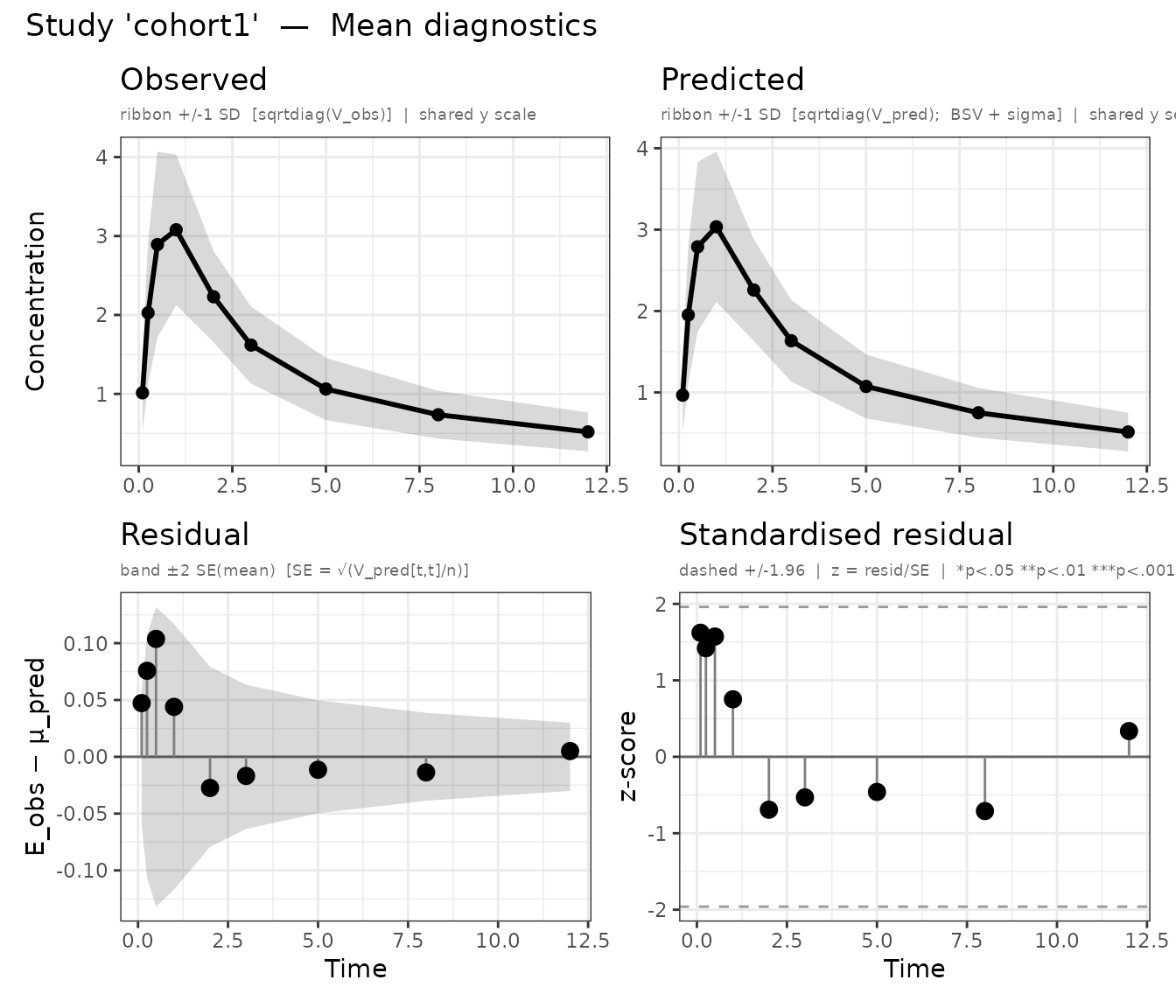
Mean diagnostics for both trials (one panel per study).
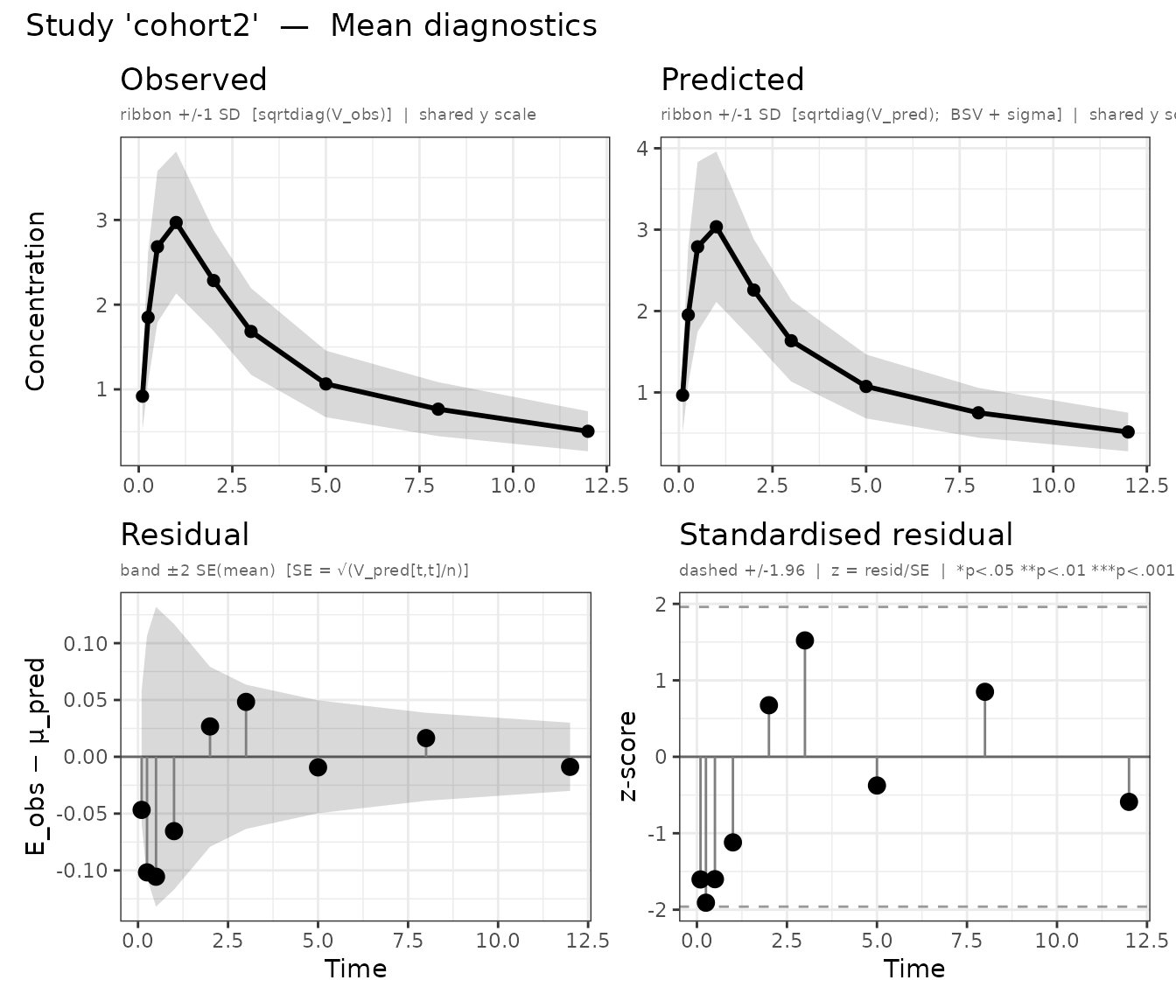
Mean diagnostics for both trials (one panel per study).
names(plots)
#>  [1] "mean_trial_a"           "mean_trial_a_obs"       "mean_trial_a_pred"
#>  [4] "mean_trial_a_resid"     "mean_trial_a_std_resid" "mean_trial_b"
#>  [7] "mean_trial_b_obs"       "mean_trial_b_pred"      "mean_trial_b_resid"
#> [10] "mean_trial_b_std_resid"
Access individual panels to compare studies side by side:
plots$mean_trial_a
plots$mean_trial_b

# Combine with patchwork if installed
if (requireNamespace("patchwork", quietly = TRUE)) {
  patchwork::wrap_plots(plots, ncol = 1)
}
Scaling to a programme
A third and fourth study are more entries in the same list, so a development programme is written the same way the two above are — one entry per trial, each with its own dose, schedule and size.
A study with a diagonal V (or a plain vector of
variances) gets method = "var", skipping the O(n_t³)
Cholesky solve there is no off-diagonal structure to justify.
See also
-
From a published figure to E, V and
n — prepare each study’s
E,Vandn - Several observed compartments — several outputs per study
- Estimator comparison