Generates up to five diagnostic panels:
Arguments
- x
An
admFitobject returned bynlmixr2()withest = "adfo",est = "admc",est = "adgh", orest = "adirmc".- which
Character vector selecting which panel types to produce. Any subset of
c("mean", "cov", "covariate", "nll", "par"). Defaults to all five. Note"cov"(predicted vs observed covariance) and"covariate"(covariate effect) are different panels.- n_sim
Number of MC samples for the final prediction. Defaults to the value used during fitting. Only used when
"mean","cov"or"covariate"is inwhich.- seed
Random seed for reproducibility.
- ...
Unused.
Value
A named list of ggplot2 objects, invisibly. Prints each selected
top-level panel. For the "mean" and "cov" panels the returned list also
contains each sub-panel individually so a single panel (or a few) can be
extracted in code without reprinting the whole grid. Elements can be pulled
out by name – plot(fit, which = "mean")$mean_study1_pred or
plot(fit, which = "cov")$cov_study1_std_resid – or by position, with the
combined 2x2 grid stored first per study
(plot(fit, which = "mean")[[1]] is the full grid, [1] the length-1
named sub-list). The sub-panel keys are <type>_<source>_obs, _pred,
_resid, and _std_resid; the combined grid stays under
<type>_<source>. <source> is the study name, and for a source cut into
nodes it is the name of the SOURCE rather than of a node – these panels
are about the paper, so the nodes are put back together first and there is
no mean_study1_s1. The extra sub-panel keys are not printed on their own.
Details
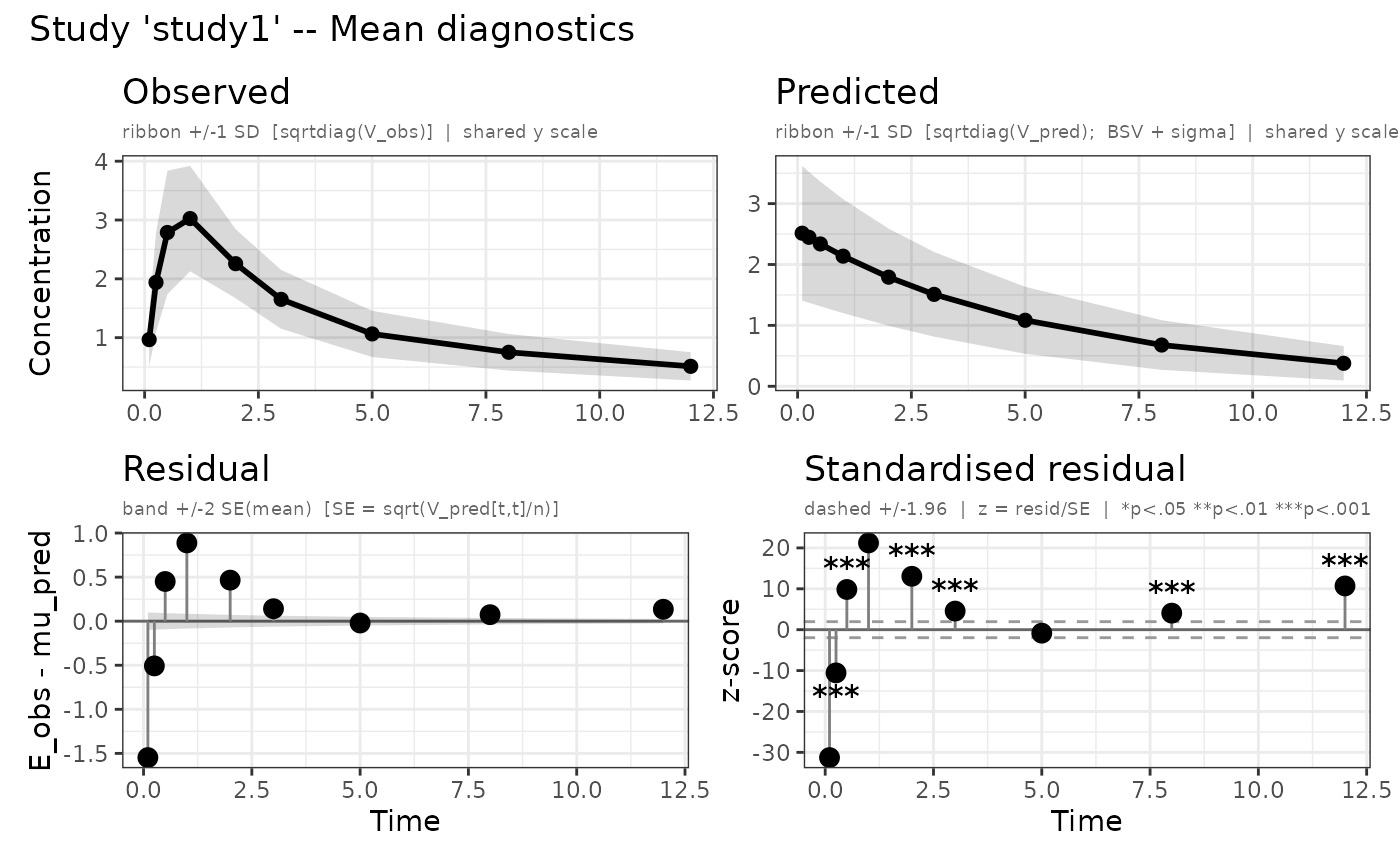
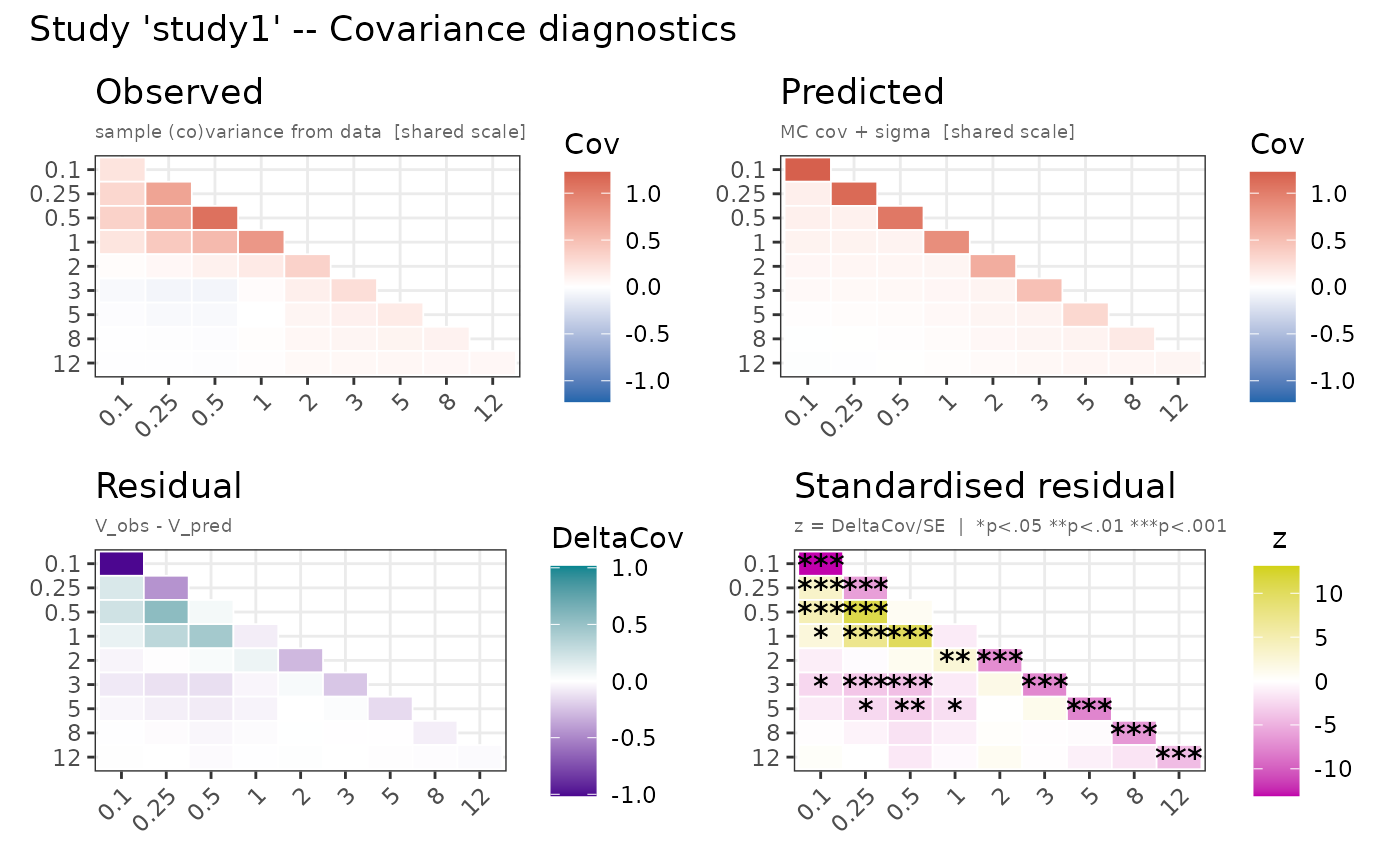
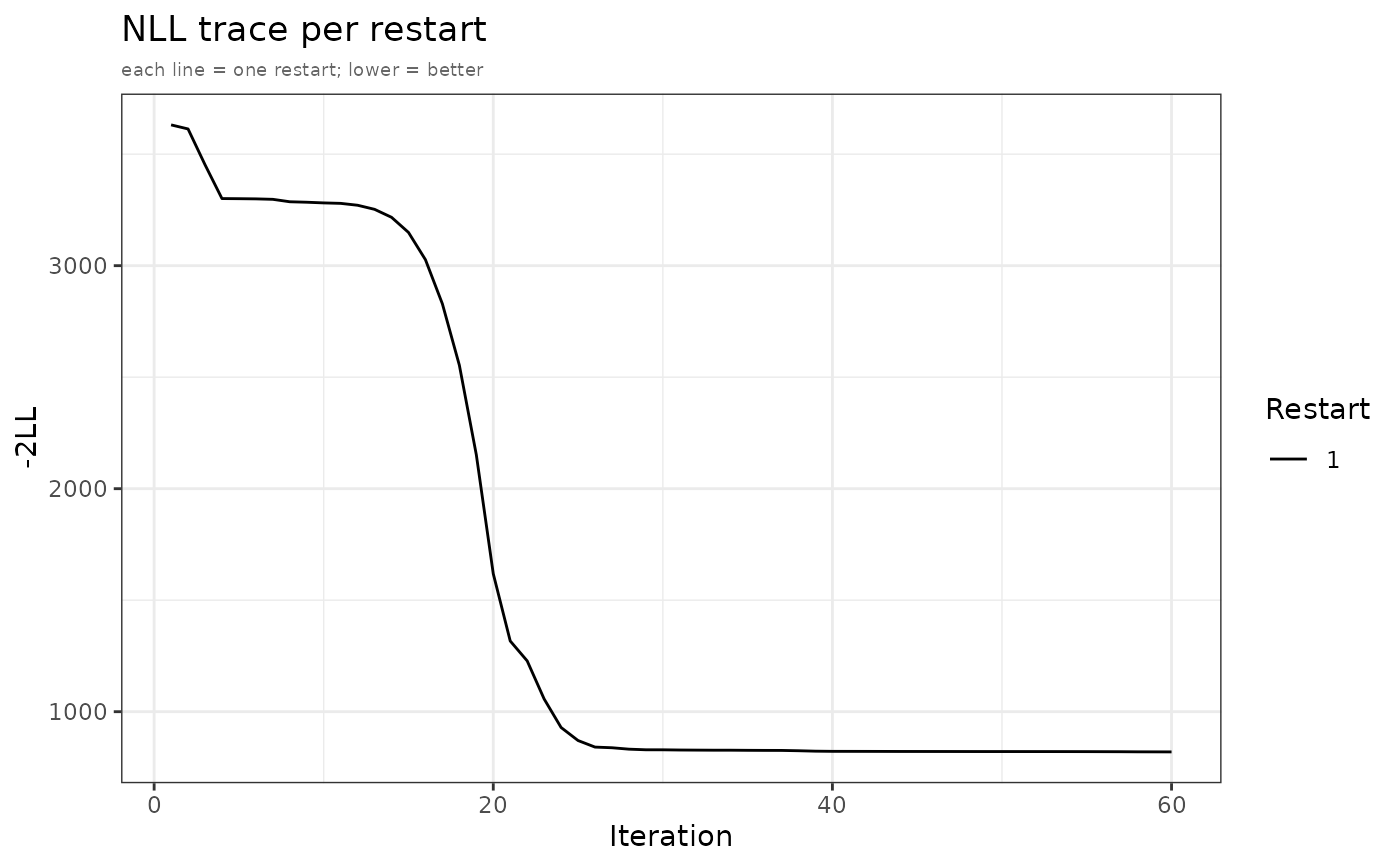
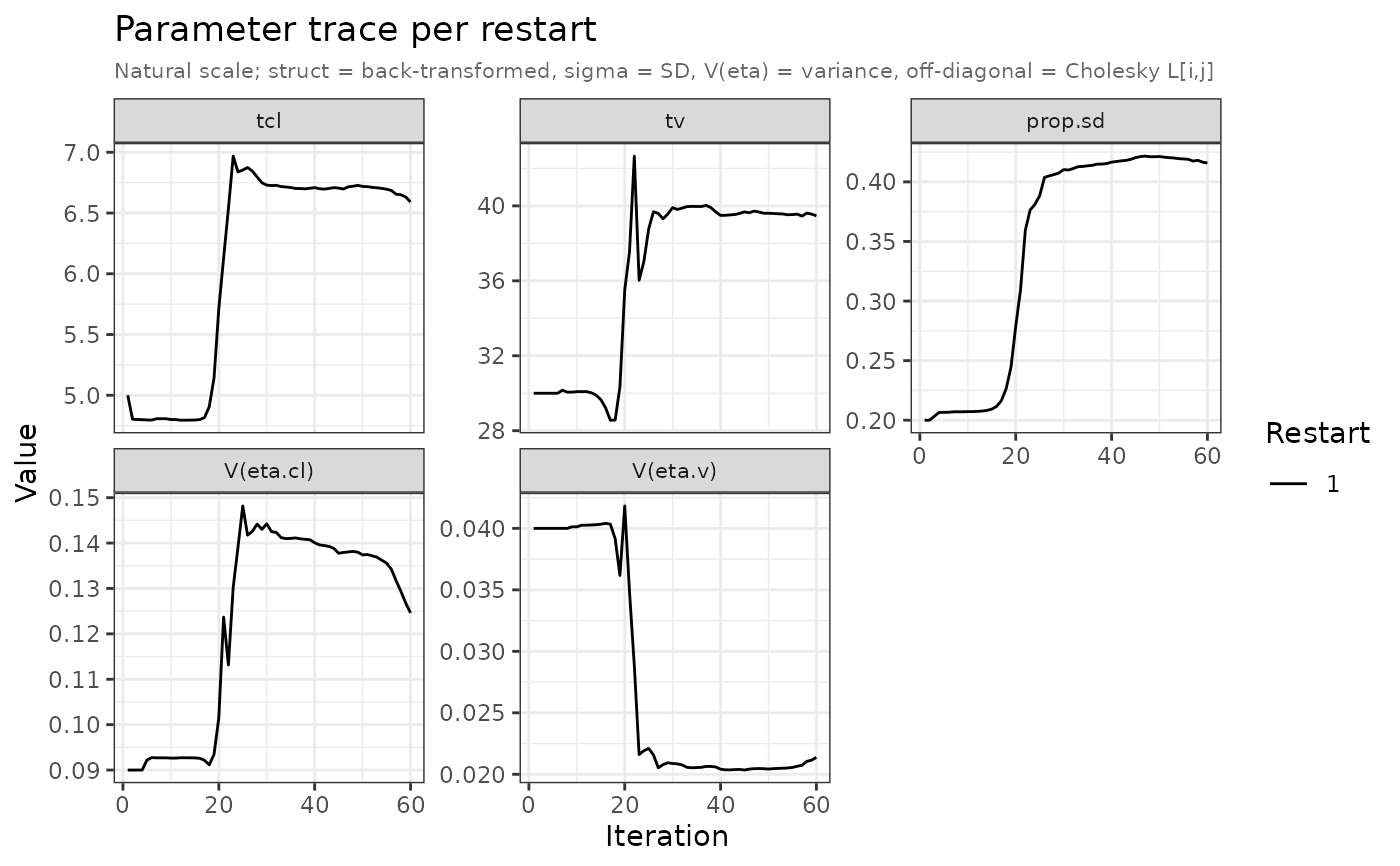
"mean"– Observed vs predicted mean per study (2x2 grid). Upper row: observed and predicted mean lines with +/-1 SD ribbon on a shared y scale (black throughout). Lower row: raw residual lollipop with +/-2 SE band and standardised residual z-scores with +/-1.96 reference lines."cov"– Observed vs predicted (co)variance heatmaps per study (2x2 grid). Upper row shares a common colour scale (blue-white-red). Lower row uses distinct diverging scales: residual (red-white-green) and standardised residual (gold-white-purple). Significance stars overlaid on the standardised residual panel."covariate"– Two BETWEEN-study covariate panels, one facet per covariate any source describes – including one the model does not read, which is exactly the casecovariate_residexists for.covariate_effectsweeps each covariate across the range the sources between them cover and draws every model parameter that reads it, at the fitted thetas, as ONE line per parameter with the other covariates held at the pooled centre; the region no source sampled is shaded as extrapolation, and a discrete covariate is drawn on its levels rather than swept through the values between them.covariate_residplots each study's mean standardised residual against the covariate value it sits at, with anlmtrend on a continuous axis: a slope there is a mis-specified covariate form. Produced only for a fit whose studies declare covariates, so it is silently absent otherwise."nll"– NLL trace per restart over optimizer evaluations. Restarts coloured with the Okabe-Ito palette."par"– Parameter trace per restart on the natural scale (struct thetas back-transformed, sigma as SD, omega diagonal as variance labelledV(eta.x)). Facets ordered as in the modelini()block. Restarts coloured with the Okabe-Ito palette.
Why the covariate panels are separate
With aggregate data a covariate effect is identified BETWEEN studies: the
renal exponent in vignette("covariates") is recovered from three cohorts
sitting at three different creatinine-clearance medians, none of which fitted
a renal term at all. The "mean" and "cov" panels are per study and in
isolation, so every source can sit beautifully on its own panel while the
relation tying them together is wrong. That contrast is what "covariate"
draws.
Marginal and conditioned sources
Both panels distinguish how each study enters a covariate, because the two
are different statements about the source rather than degrees of the same
one. A marginalised covariate – one the estimator integrates over a
declared distribution – is drawn as a round point at the study's median with
a 10th-90th percentile bar and a 2.5th-97.5th whisker: the source constrains
the effect through the spread it induces, and the whole span is what it
speaks for. A conditional covariate – cut into nodes, or at or by, so the model
is solved at one value – is drawn as a diamond at that value with no spread,
because it has none; what that source reports along it is a relationship,
drawn as its own regression over the range it covers.
A SOURCE IS ONE MARK, not one per stratum. Conditioning cuts a source into one study per quadrature node, and a node is an internal discretisation of the very distribution the source already stands for: drawn straight it became nine small dots for one paper, each carrying a ninth of its patients, with the outermost node setting the axis. On a LEVEL axis the positions are values the paper actually reported, so a source appears once per level.
Reading covariate_resid
A continuous covariate is read as a trend: the dashed lm across studies,
where a slope is a mis-specified covariate form.
A discrete one is read as a contrast instead, and is drawn that way. Its
axis is ticked at its levels and nowhere else, no regression is fitted
through it – a line across the levels of a factor reports as a slope what is
a difference between groups – and the strata stratify cut from one source
are joined, because that pairing is the evidence conditioning creates: the same
study, one covariate moved. Several sources tilting the same way is the
mis-specification. A regression over the pooled cloud of strata cannot show
it, since it averages the pairs away.
With few sources, covariates whose study medians happen to move together cannot be told apart here – three cohorts whose weights and renal function both decline will show a slope in both facets whichever one is mis-specified. The panel localises the problem to a set of covariates, not to one; separating them needs a source that breaks the pattern.
Aggregate data slot
Every admixr2 fit also carries the observed and predicted aggregate data in
fit$env$aggData, a named list with one entry per study. Each entry holds the
observation times, the study n, and two moment sets – obs (from the
data) and pred (predicted at the fitted parameters) – each a list with the
mean vector E and the (co)variance matrix V:
  fit$env$aggData$study1$obs$E    # observed mean vector
  fit$env$aggData$study1$obs$V    # observed covariance matrix
  fit$env$aggData$study1$pred$E   # predicted mean vector
  fit$env$aggData$study1$pred$V   # predicted covariance matrix
The predicted moments are computed by one MC simulation at the fitted
parameters using the fit's own n_sim and a fixed seed. The slot is absent
only when the fit cannot be simulated (no simulation model available).
It is per study, which for a source cut into nodes means per node –
where the "mean" and "cov" panels are per SOURCE, the nodes put back
together by the mixture law. So the two no longer line up entry for entry on
such a fit, and the panel keys are mean_<source> rather than
mean_<source>_s1. admMoments() returns whichever of the two you want,
tidied: by = "source" matches the panels, by = "stratum" matches this
slot.
nlmixr2 traceplot()
admixr2 fits also plug into the nlmixr2 traceplot() generic. During fitting
the parameter iteration history of the best restart is stored on the fit in
the standard parHistData slot (natural scale), so traceplot(fit) produces
the familiar per-parameter, free-y facetted trace used elsewhere in the
nlmixr2 ecosystem. There is no burn-in marker (admixr2 records optimizer
evaluations, not SAEM iterations), and only the best restart is shown – the
per-restart overlay and the NLL trace remain available via
plot(fit, which = c("par", "nll")). The trace stores only improving
evaluations (steps that lowered the best NLL), so the iter axis indexes
those improvement steps rather than raw optimizer iterations.
Examples
# \donttest{
library(rxode2)
library(nlmixr2)
data("examplomycin")
obs <- examplomycin[examplomycin$EVID == 0, ]
obs <- obs[order(obs$ID, obs$TIME), ]
times <- sort(unique(obs$TIME))
ids <- unique(obs$ID)
dv_mat <- do.call(rbind, lapply(ids, function(i) {
sub <- obs[obs$ID == i, ]; sub$DV[order(sub$TIME)]
}))
E <- colMeans(dv_mat)
V <- cov.wt(dv_mat, method = "ML")$cov
pk_model <- function() {
ini({
tcl <- log(5); tv <- log(30)
prop.sd <- c(0, 0.2)
eta.cl ~ 0.09; eta.v ~ 0.04
})
model({
cl <- exp(tcl + eta.cl)
v <- exp(tv + eta.v)
d/dt(central) <- -(cl/v) * central
cp <- central / v
cp ~ prop(prop.sd)
})
}
fit <- nlmixr2(
pk_model, admData(), est = "adfo",
control = adfoControl(
studies = list(study1 = list(E = E, V = V, n = length(ids),
times = times, ev = et(amt = 100))),
maxeval = 100L
)
)
#>
#>
#>
#>
#> ℹ parameter labels from comments are typically ignored in non-interactive mode
#> ℹ Need to run with the source intact to parse comments
#> === admixr2: Aggregate Data Modeling (FO) ===
#> Obs units: 1 | Params: 5 | Cores: 2 | Grad: Analytical | Restarts: 1
#> +----------+----------+----------+----------+----------+----------+----------+
#> | | -2LL | tcl | tv | prop.sd | eta.cl | eta.v |
#> +----------+----------+----------+----------+----------+----------+----------+
#> | 0010 | 1768.15 | 4.967 | 29.88 | 0.2587 | 0.0888 | 0.04603 |
#> | 0020 | 862.47 | 6.391 | 37.74 | 0.3864 | 0.08003 | 0.0422 |
#> | 0029 ✓ | 861.90 | 6.384 | 38.03 | 0.39 | 0.08051 | 0.04074 |
#> | 0.8 sec | | | | | | |
#> Computing covariance (R method, Analytical-Hessian, sandwich, 6 gradient evaluations)
#> → compress origData in nlmixr2 object, save 1160
#>
#>
plot(fit)
 # }
# }